Get a Quote
Learn how AI search optimization, semantic SEO, schema, FAQ content, topical authority, and answer-ready pages improve search visibility.
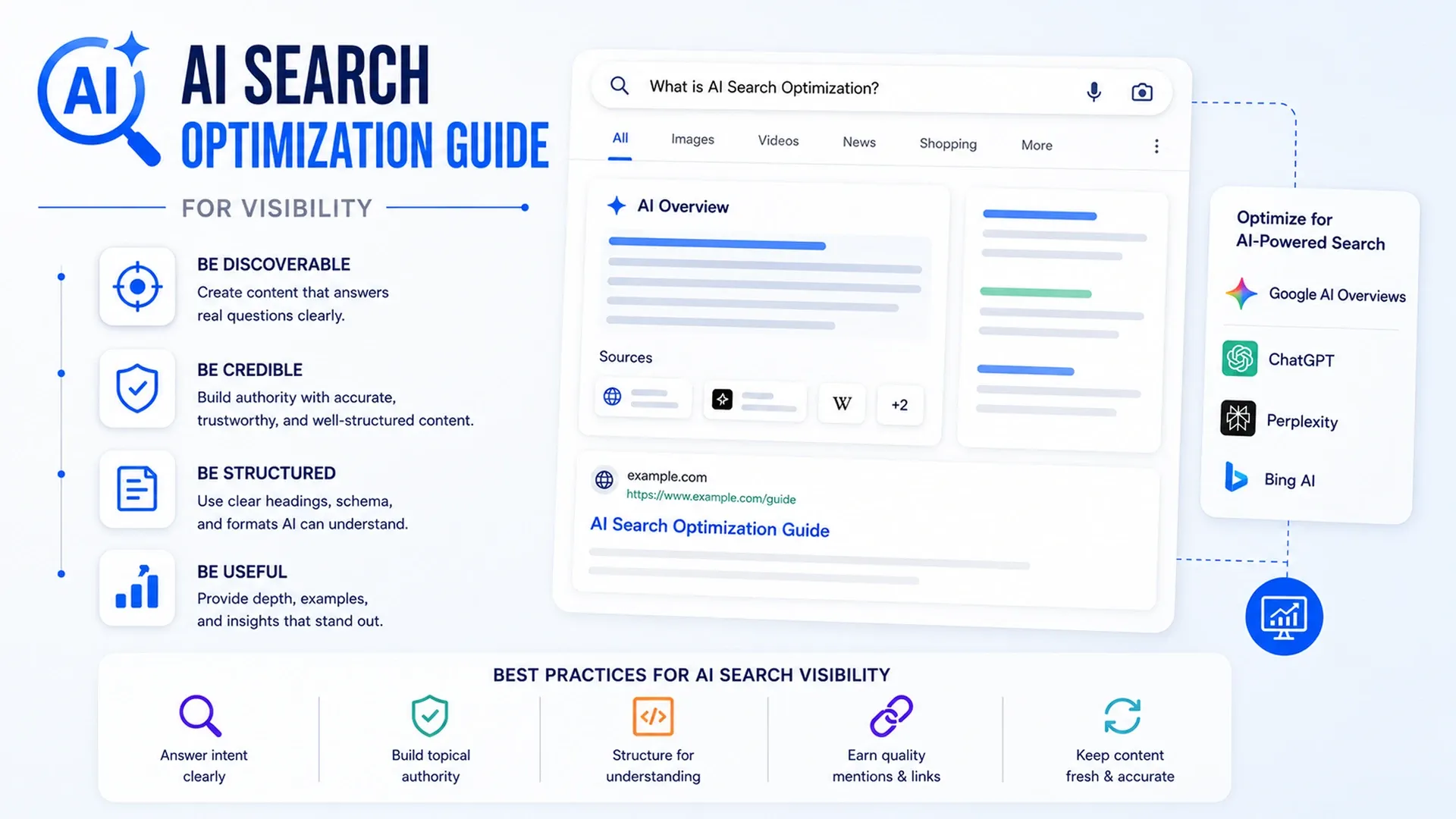
Search results increasingly answer a question directly on the results page itself, often without a single click landing on any website at all. A serious AI search optimization guide has to start from that shift: ranking first no longer guarantees visibility if an AI Overview or answer engine can summarize the answer without ever sending the visitor anywhere, which means a page can technically rank well and still receive almost no traffic to show for it.
This shift isn't limited to Google's own AI Overviews either - tools like ChatGPT, Perplexity, and Bing's AI-powered search all pull from the same pool of indexed, credible content, which means the same underlying strategy tends to pay off across all of them rather than needing a separate playbook for each one.
Writing for Entities and Meaning, Not Just Keywords
Matching an exact keyword phrase used to be enough to signal relevance; a modern semantic SEO strategy now needs content that demonstrates real understanding of a topic's related concepts, not just the phrase itself. Search systems increasingly read for entities and relationships between ideas, closer to how a person would explain the subject out loud - a shift our on-page and content SEO guide explores from the writing side.
- Content organized around topics and entities, not isolated keyword phrases
- Natural language that matches how people actually ask questions aloud
- Comprehensive coverage of a subject instead of thin, single-angle pages
- Clear internal links connecting related concepts across the site
This doesn't mean keyword stuffing has simply been replaced by entity stuffing - cramming every related term into a page without genuine explanation reads just as poorly to an AI system as it always did to a human reader. The goal is coverage that comes from actually understanding the subject, not a checklist of related terms inserted for the sake of it.

Structuring Content So AI Overviews Can Quote It
Getting quoted inside an AI Overview depends heavily on structure, and practical AI Overview SEO tips usually start with putting a clear, direct answer near the top of a section instead of burying it under three paragraphs of preamble. Headings phrased as the actual questions people ask make it easier for an AI system to isolate the right passage to cite.
Writing in something closer to an inverted pyramid - the core answer first, supporting detail and nuance after - tends to serve both audiences at once. A human skimming the page gets the answer immediately, and an AI system extracting a passage to cite doesn't have to wade through several paragraphs of preamble to find it.
Building FAQ Content That Matches How People Actually Ask
A thorough answer engine optimization guide treats FAQ sections as more than a courtesy add-on at the bottom of a page - they're often the exact format tools like Google's AI Overviews, ChatGPT, and Perplexity pull from when constructing an answer. Structured FAQ schema helps make that content easy for those systems to parse and trust, provided the questions genuinely reflect what people ask rather than a list of keyword variations dressed up as questions.
AI search doesn't rank a page anymore - it decides whether the page is worth quoting at all.
Schema markup extends well beyond FAQ pages - Organization, Article, and Review schema all give search and AI systems structured, unambiguous facts to work from instead of having to infer them from prose, which matters more now that those systems are synthesizing an answer rather than simply linking to a page.
Where This Fits Alongside Traditional SEO
None of this replaces the fundamentals - a page still needs solid technical health and genuine authority behind it before an AI system will trust it enough to cite. Our technical SEO guide and link building and authority guide cover the groundwork that makes everything above actually count for something, since no amount of semantic polish rescues a page an AI system has no reason to trust in the first place.