Get a Quote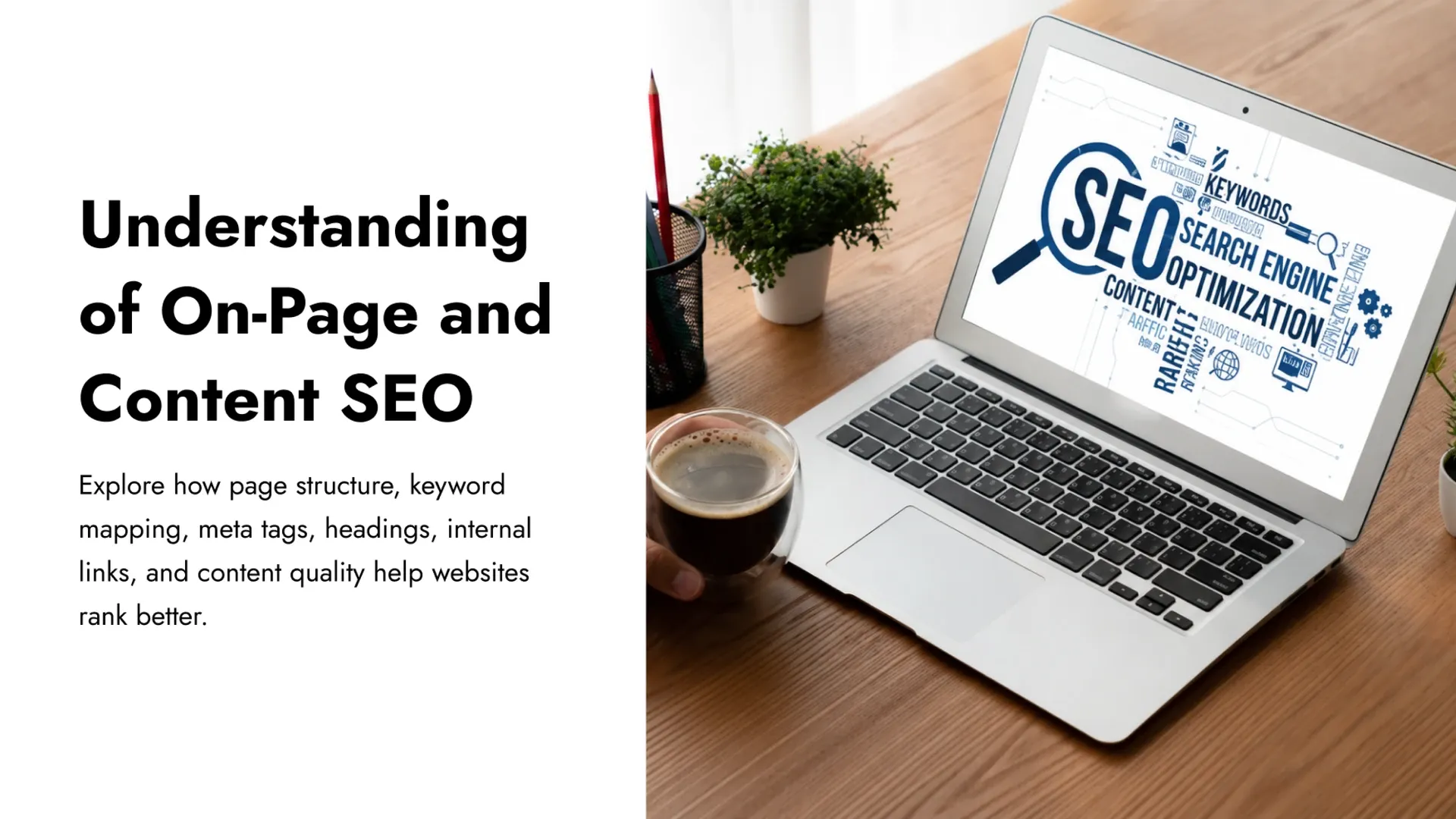
Learn how on-page and content SEO improve meta tags, headings, keyword mapping, internal links, content quality, and search rankings.
On-page and content SEO is where search strategy meets the actual experience of reading a page. Even a technically perfect website won't rank well if its pages don't clearly signal what they're about, target the right keywords, or provide content genuinely useful to the people searching for it. This is the layer of SEO most directly shaped by writing, structure, and intent — and unlike technical fixes, it requires ongoing attention as search behavior and content quality expectations continue to evolve.
Getting Meta Tags Right
Title tags and meta descriptions are often the first thing a searcher sees, appearing directly in search results before anyone clicks through. Staying within recommended lengths, a core part of meta tag optimization, keeps them from being cut off:
Element | Recommended Length | Purpose |
|---|---|---|
Title Tag | 50–60 characters | Summarizes the page, shown as the clickable headline |
Meta Description | 150–160 characters | Encourages clicks with a clear value proposition |
Beyond length, both should reflect what the page actually delivers — mismatched expectations lead to clicks that bounce right back to search results, which search engines eventually interpret as a signal that the page didn't satisfy the searcher.
Mapping Keywords to the Right Pages
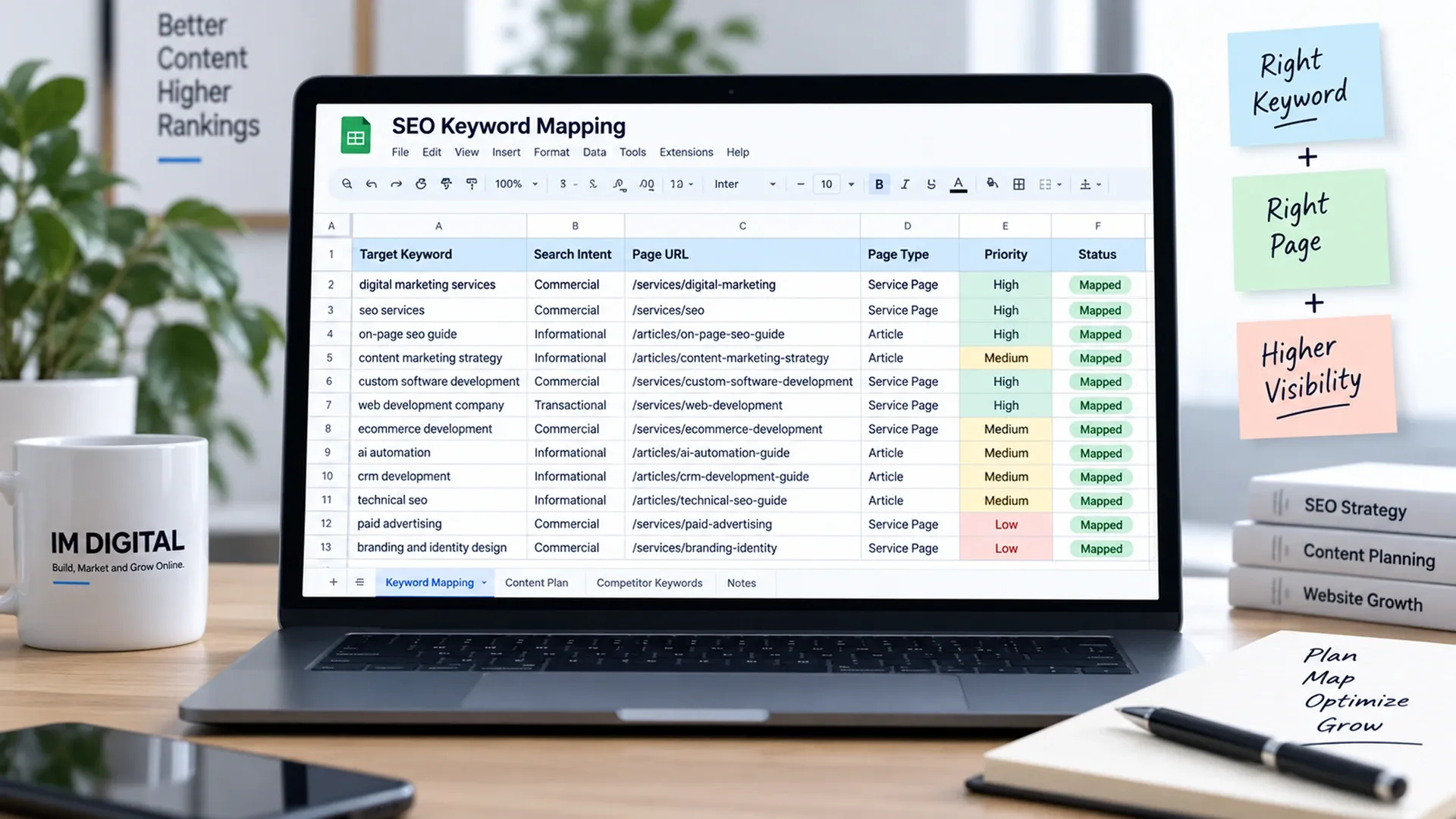
One of the most common on-page mistakes is targeting the same keyword across multiple pages, which forces a site to compete against itself in search results instead of one clear page winning that ranking. A solid keyword mapping strategy assigns each important term to a single, most relevant page, based on search intent — informational, commercial, or transactional. This keeps a site's structure aligned with how people actually search, rather than scattering relevant content across pages that dilute each other's authority. A simple spreadsheet mapping keywords to URLs is often enough to catch overlap before it becomes a structural problem.
What Makes Content Actually Rank
Beyond keywords and meta tags, ranking well over the long term comes down to a few consistent, repeatable qualities, closely aligned with Google's own guidance on creating helpful content:
- Content that fully answers the searcher's actual question
- Clear headings that organize information logically
- Internal links that connect related pages naturally
- Regular updates that keep information accurate over time
- A broader content marketing plan behind individual pages, not just isolated posts
Structuring Content With Headings
Headings do more than break up a wall of text — they give both readers and search engines a clear outline of what a page covers and how its ideas relate to one another. A single <h1> should describe the page's main topic, while <h2> and <h3> headings organize supporting sections in a logical hierarchy rather than a flat list of unrelated points. Skipping this structure, or using headings purely for visual styling rather than genuine organization, makes it harder for search engines to understand which sections matter most and harder for readers to scan the page for the specific part they need.
Avoiding Thin and Duplicate Content
Pages that say very little, or that repeat what's already covered elsewhere on the same site, rarely rank well no matter how carefully their meta tags are optimized.
Search engines are designed to reward genuine depth and discourage near-duplicate pages competing for the same query.
A handful of thorough, well-organized pages consistently outperforms a larger number of thin ones covering the same ground. Consolidating overlapping pages into a single, comprehensive resource — rather than publishing several shallow variations of the same topic — tends to improve rankings for the surviving page rather than diluting them.
These fundamentals — reliable content SEO tips more than one-off tricks — turn individual pages into clear, relevant answers to real search queries. Getting meta tags right, mapping keywords deliberately, structuring content with genuine hierarchy, and consistently producing thorough, non-duplicate content gives every page the best possible chance to rank — and to actually satisfy the people who find it. Pair this with the fundamentals in our technical SEO guide for the full picture.