Get a Quote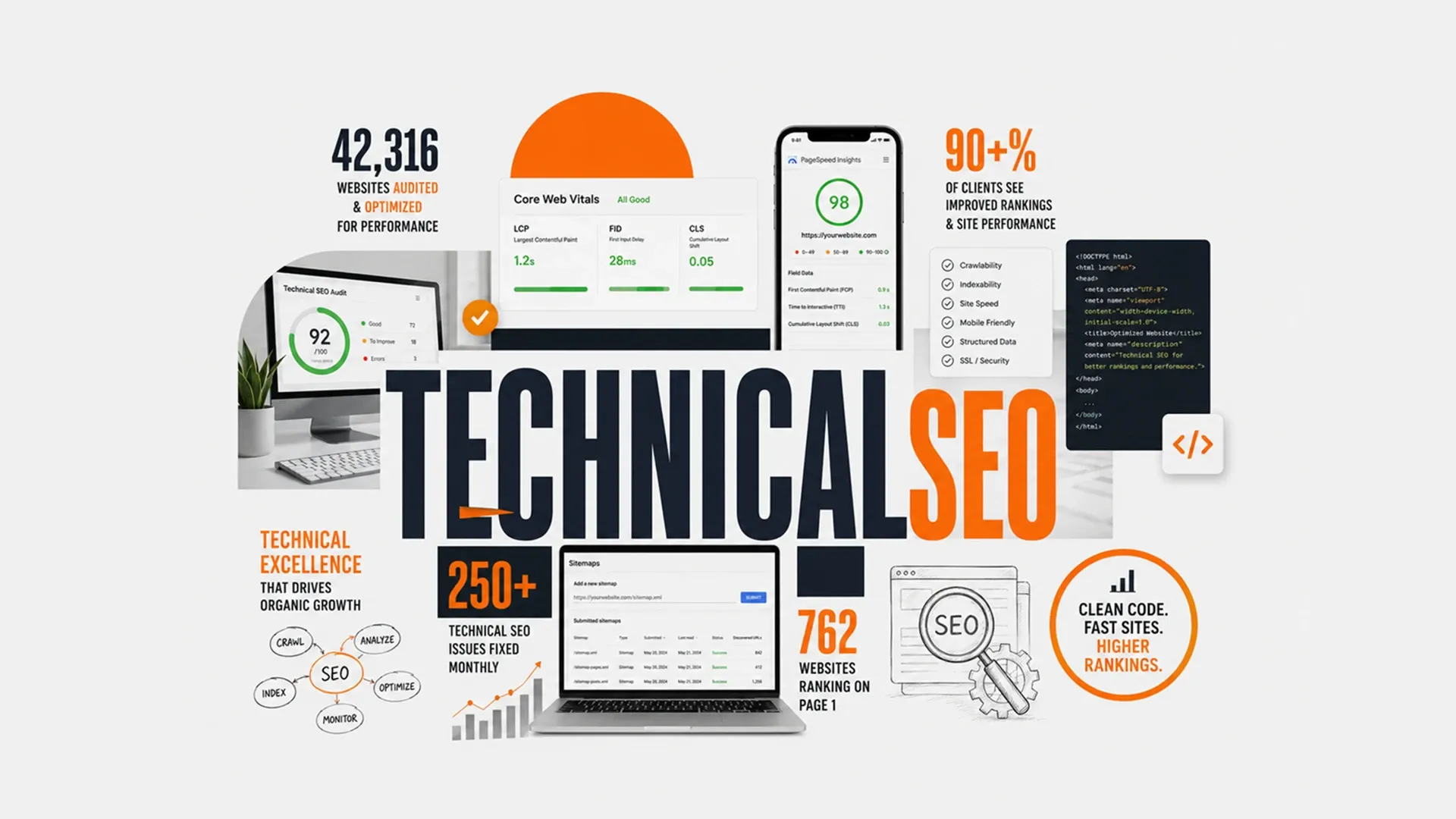
Learn how technical SEO improves crawlability, speed, Core Web Vitals, indexing, schema markup, mobile usability, and search visibility.
Technical SEO is the foundation everything else in search optimization is built on. Great content and strong backlinks matter far less if search engines can't crawl a site efficiently, if pages load too slowly, or if technical errors prevent important pages from being indexed at all.
Getting the technical layer right doesn't guarantee rankings, but ignoring it puts an artificial ceiling on how well a site can ever perform.
Core Web Vitals: The Metrics That Matter
Google measures user experience through a specific set of performance metrics known as Core Web Vitals, which factor directly into how pages rank:
Metric | What It Measures | Good Threshold |
|---|---|---|
LCP (Largest Contentful Paint) | Loading speed of main content | Under 2.5 seconds |
INP (Interaction to Next Paint) | Responsiveness to user input | Under 200 milliseconds |
CLS (Cumulative Layout Shift) | Visual stability while loading | Under 0.1 |
These aren't arbitrary numbers — they're direct measurements central to Core Web Vitals optimization, and the underlying fixes usually come down to solid frontend development practices covered in our frontend development guide.
Helping Search Engines Understand Pages with Schema
Structured data, commonly added as JSON-LD, gives search engines explicit information about what a page contains — a product, an article, a business location — beyond what they can infer from raw text alone:
{
  "@context": "https://schema.org",
  "@type": "Article",
  "headline": "Technical SEO Guide for Better Search Visibility",
  "author": "IM Digital"
}
Well-implemented schema doesn't guarantee rich results in search, but it removes ambiguity, and search engines consistently reward pages they can understand with confidence. Different content types have their own schema formats — Product, FAQPage, Event, and Review all follow slightly different structures, so it's worth matching the markup to what a page actually is.
Crawlability and Indexation Basics
Good website crawlability starts with the basics — search engines need to be able to find and index a site's pages in the first place. A few fundamentals keep that process running smoothly:
- A clean, updated XML sitemap submitted to search consoles
- A robots.txt file that doesn't accidentally block important pages
- Canonical tags that prevent duplicate content confusion
- Internal linking that helps crawlers discover every important page
Mobile Usability as a Ranking Factor
Search engines primarily crawl and rank websites based on their mobile version, a practice known as mobile-first indexing, which means a site that looks fine on desktop but breaks on smaller screens is effectively showing search engines its worst version. Common mobile issues — text too small to read without zooming, buttons placed too close together, content that requires horizontal scrolling — don't just frustrate visitors, they actively work against rankings. Testing a site specifically on mobile devices, rather than assuming a responsive design automatically handles everything correctly, catches problems that desktop testing alone consistently misses.
Fixing Broken Links and Redirect Chains
As a website grows and changes over time, broken links and messy redirect chains accumulate quietly in the background. A visitor or crawler following a link that leads to a dead page wastes crawl budget and creates a poor experience, while long redirect chains — a page that redirects to another redirect, which redirects again — slow down both users and search engines trying to reach the final destination. Larger sites with thousands of pages feel this most acutely, since even a small percentage of broken links can add up to a meaningful chunk of wasted crawl budget. Regularly auditing internal and external links, and replacing chains with single, direct redirects, keeps a site's technical foundation clean as it scales rather than accumulating debt that gets harder to untangle over time.
Technical SEO rarely gets the spotlight that content and backlinks do, but it determines whether all that other work even has a chance to perform. Strong Core Web Vitals, well-implemented schema, solid crawlability fundamentals, and genuine mobile usability give search engines every reason to trust and rank a site — and give visitors a faster, more reliable experience along the way. Treating it as ongoing maintenance, guided by regular technical SEO audit habits, rather than a one-time setup task, keeps a site's technical foundation solid as it grows.