Get a Quote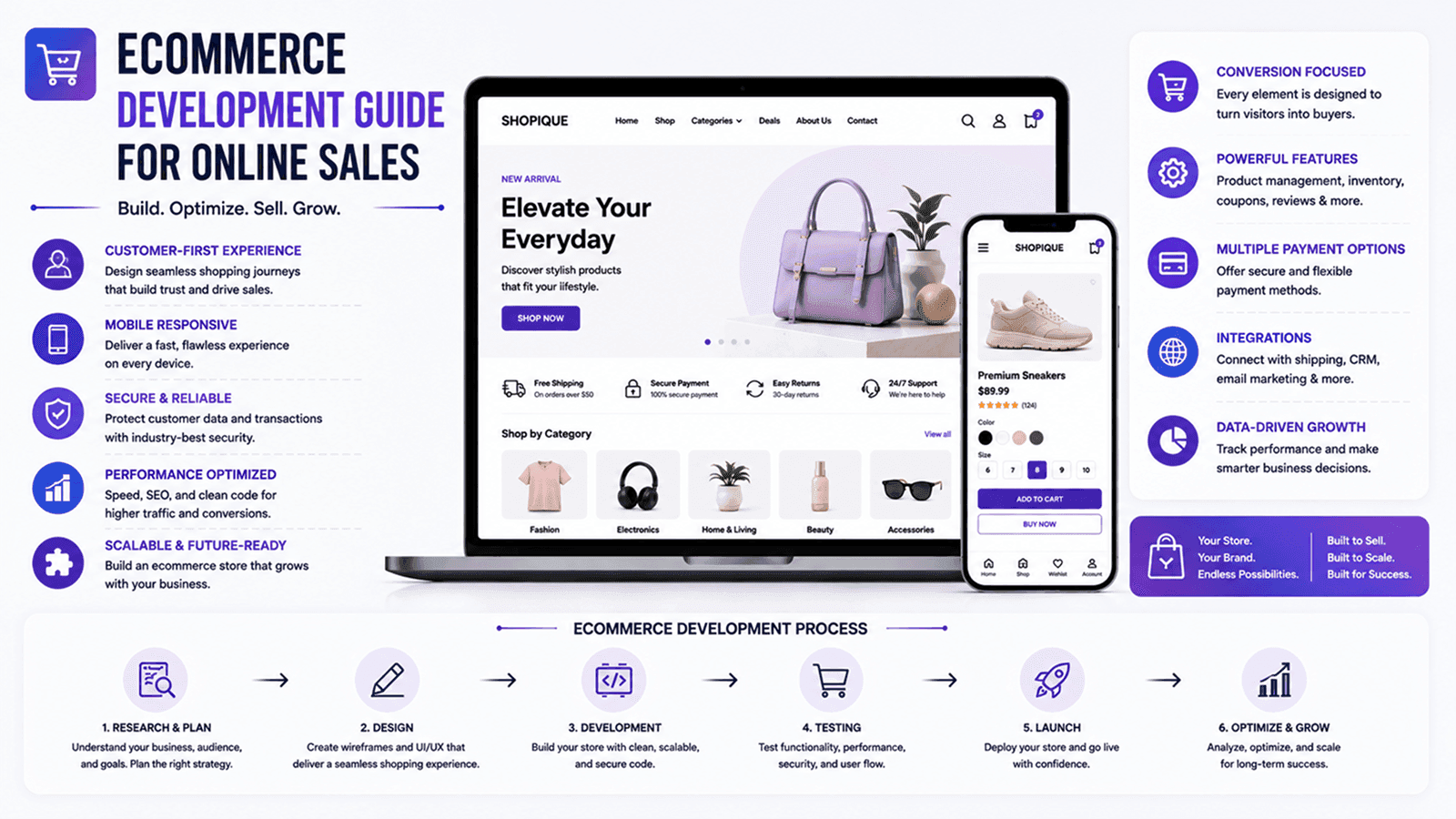
Learn how ecommerce development supports product catalogs, checkout, payments, SEO, inventory, user journeys, and online sales growth.
An ecommerce site isn't a brochure with a shopping cart bolted on - every page exists to move a browsing visitor a step closer to checkout. A solid ecommerce development guide treats that difference as the starting point: product pages, categories, and even the footer all carry more weight here than they would on a standard business site, because each one is a chance to either build confidence or lose the sale, often within the same single visit.
Organizing a Catalog Customers Can Actually Browse
Large catalogs fail quietly when customers can't narrow down options fast enough to feel in control of their search. Good online store development tips usually start with the unglamorous parts - consistent product data, sensible categories, and filters that actually match how customers think about the products, not how a spreadsheet happens to be organized.
- Category structures that mirror how customers search, not internal warehouse groupings
- Filters for price, size, color, and other attributes that actually matter to buyers
- Clean, consistent product data so search and filtering behave predictably
- Fast on-site search that forgives typos and partial matches
Product photography and detail pages carry as much persuasive weight as the copy around them. A shopper who can't zoom into fabric texture, see a product from multiple angles, or gauge scale next to a familiar object is left guessing, and guessing rarely ends in a completed purchase.
[Image: An online store's product listing page showing organized categories, filters, and search results]
Designing Checkout to Reduce Drop-Off
Checkout is where the sale is either won or lost in the space of a few clicks, which is exactly why ecommerce checkout optimization deserves as much attention as the homepage does. Guest checkout options, a minimal number of form fields, and visible trust badges near the payment step all chip away at the hesitation that causes carts to sit abandoned, a problem conversion research has tracked across online retail for years, and one that gets noticeably worse on mobile screens where every extra tap adds friction.
Payment and shipping also need to work reliably behind the scenes, not just look clean on the surface. Connecting multiple payment gateways and shipping calculators without breaking under real order volume is really an integration problem as much as a design one, which our API integration guide covers in more depth.
Building for Custom Catalogs and Business Rules
Off-the-shelf themes work well until a business needs bulk pricing tiers, complex product variants, or B2B-specific rules a template was never built to express. That's usually the point where custom ecommerce website development becomes worth the investment - not to replace a platform, but to extend it past its default assumptions. Brands whose catalog fits neatly within a platform's defaults, meanwhile, are often better served by our Shopify website development guide instead of a fully custom build.
Wholesale and B2B storefronts push this even further, often needing separate pricing per account, minimum order quantities, or an entirely different checkout flow than the retail side of the same business - requirements that rarely fit inside a standard theme's assumptions no matter how many settings it exposes.
An ecommerce store rarely fails at the homepage - it fails one screen before checkout, the moment friction outweighs desire.
Keeping Inventory and Orders in Sync
None of the above holds up if the store sells something that's actually out of stock. Reliable ecommerce depends on inventory numbers updating the instant an order is placed, which is where a dedicated inventory management system usually earns its keep once order volume passes what a spreadsheet can track safely.
Optimizing for Search and Discovery
A well-built store still needs to be found before any of this matters. Product and category pages should be treated as their own landing pages - each with a clear title, unique description, and enough genuine content to rank instead of relying on manufacturer copy every competitor is using word for word. Getting the fundamentals right here compounds every other investment made across the catalog, checkout, and inventory systems above, since traffic that never arrives has no chance to experience any of it.