Get a Quote
Learn how AI agent development helps businesses automate tasks, connect tools, support teams, process data, and improve productivity.
A chatbot that answers a question and an agent that actually completes a task look similar on the surface, but the difference matters enormously once real business processes are on the line. A grounded AI agent development guide starts by drawing that line clearly: an agent doesn't just respond, it acts - checking a database, updating a record, or triggering the next step in a workflow on its own, often chaining several of those actions together to finish something that used to require a person switching between three different tools.
What Separates an Agent From a Simple Chatbot
A simple chatbot answers one question at a time from a fixed script or a single model response; a genuine AI agent plans across several steps and calls real tools to get there. Practical custom AI agent development tips focus on giving an agent memory of what it's already done, access to the right tools, and enough structure to know when to stop and ask rather than guess, especially when a wrong guess would be expensive or hard to undo.
- Access to specific tools and APIs, not just a conversational text response
- Memory of prior steps within a task, not a fresh start every message
- Multi-step planning instead of a single question-and-answer exchange
- Clear stopping points where the agent asks instead of assuming
A support agent and a task agent look different on the surface - one is having a conversation, the other is quietly working through a checklist - but both rely on the same underlying capability: knowing which tool to call, when to call it, and when the safest move is simply asking a human instead.
Connecting Agents to Real Business Tools
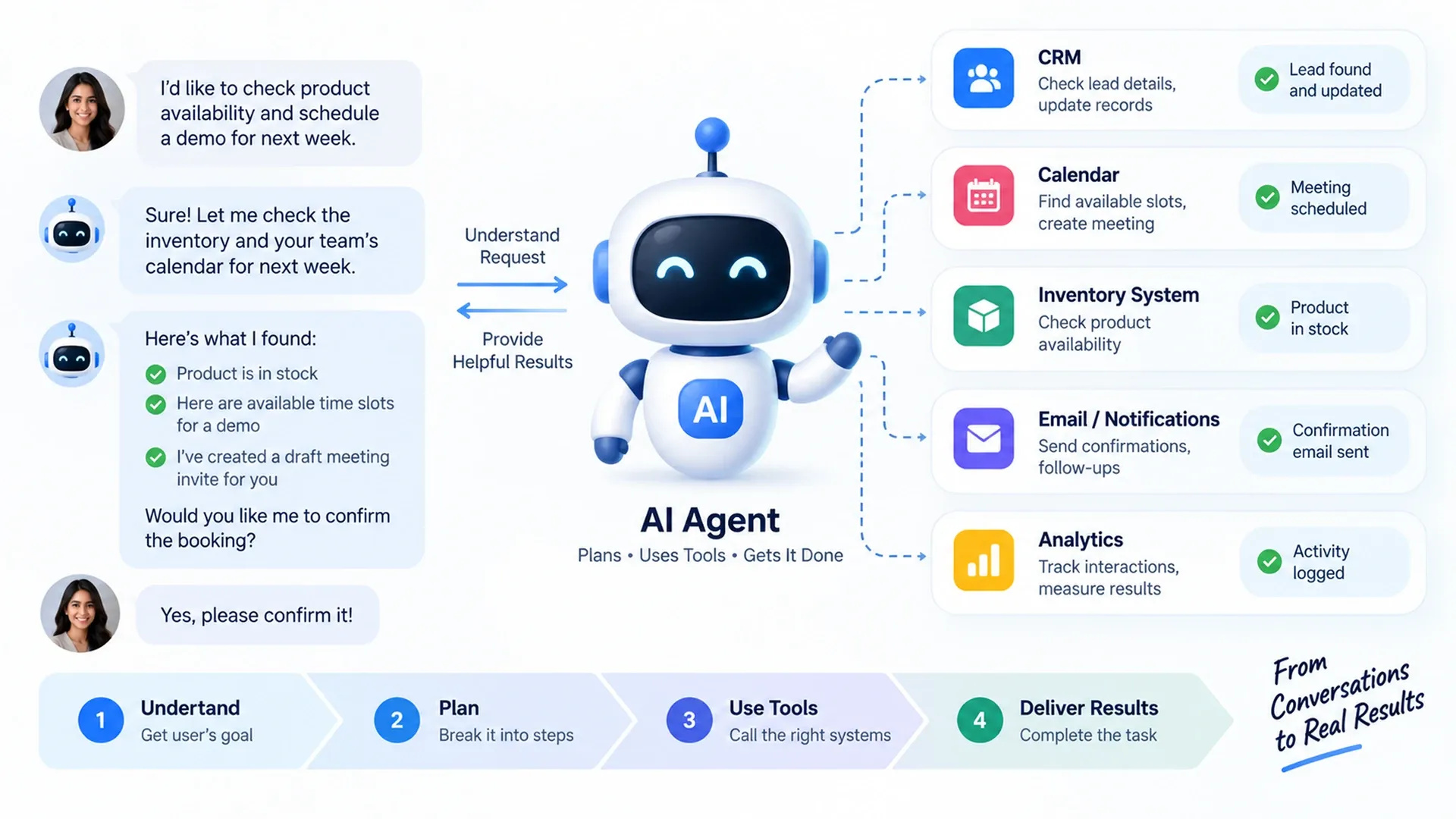
None of that planning ability matters if the agent can't actually touch the systems a business runs on. AI agents for business automation get their value from tool definitions that describe exactly what an agent is allowed to do - creating a CRM lead, checking stock, or scheduling a follow-up - each one scoped narrowly enough that the agent can't overstep it by accident, the same discipline that makes an API integration reliable rather than a liability.
{
  "name": "create_crm_lead",
  "description": "Creates a new lead record in the CRM",
  "parameters": {
    "type": "object",
    "properties": {
      "name": { "type": "string" },
      "email": { "type": "string" },
      "source": { "type": "string" }
    },
    "required": ["name", "email"]
  }
}
Testing an agent's tool use in a sandboxed environment before granting it access to production systems catches most of the embarrassing mistakes early. A malformed request that would have created a dozen duplicate records is far cheaper to discover in staging than after it's already happened to real customer data.
Deciding What an Agent Should Be Allowed to Do Alone
Not every action deserves the same level of trust. A responsible AI productivity agent guide separates low-risk actions an agent can complete independently - drafting a summary, checking a status - from higher-stakes ones like sending an external email or processing a refund, which stay behind a human approval step until the agent has earned more confidence through a track record of getting the lower-stakes actions right first.
An agent that can take action without oversight isn't more useful - it's just a mistake that happens faster.
Where Agents Fit Alongside Broader Automation
AI agents rarely replace a business's existing automation - they extend it, adding judgment to workflows that were previously either fully manual or too rigid for simple rule-based automation to handle. Our guides to business process automation and AI customer support automation cover the more structured, workflow-driven side of that same automation effort, and most businesses find the two approaches work best layered together rather than chosen as an either-or.