Get a Quote
Learn how mobile app development helps businesses improve engagement, customer experience, loyalty, automation, and digital growth.
A mobile app can become one of the most direct lines a business has to its customers — living on their home screen, sending timely updates, and making everyday interactions faster than a website ever could. But building an app is a significant investment, and the decisions made early, from platform strategy to user experience, shape whether that investment pays off. Understanding how modern mobile app development works helps businesses avoid costly missteps and build apps that customers actually keep.
Choosing the Right Development Approach
One of the first decisions in any iOS and Android app strategy is whether to build natively for both platforms or use a cross-platform framework that shares code across them. Native development typically delivers the smoothest performance and the deepest access to device features, while cross-platform approaches let teams move faster and maintain a single codebase. Neither option is universally better — the right choice depends on budget, timeline, and how much the app depends on complex, platform-specific functionality.
Aspect | Native (iOS/Android) | Cross-Platform |
|---|---|---|
Performance | Highest, closest to hardware | Very good for most use cases |
Development Cost | Higher, two separate codebases | Lower, shared codebase |
Time to Market | Slower | Faster |
Best For | Complex, performance-heavy apps | MVPs and most business apps |
For most businesses building booking systems, loyalty apps, or service platforms, cross-platform app development strikes the right balance between speed, cost, and quality. Native development becomes worth the extra investment when an app depends heavily on device-specific performance, like real-time graphics or advanced hardware integration. None of this matters without a reliable backend behind it — the fastest app still depends on APIs that respond quickly and consistently.
Designing for Engagement and Retention
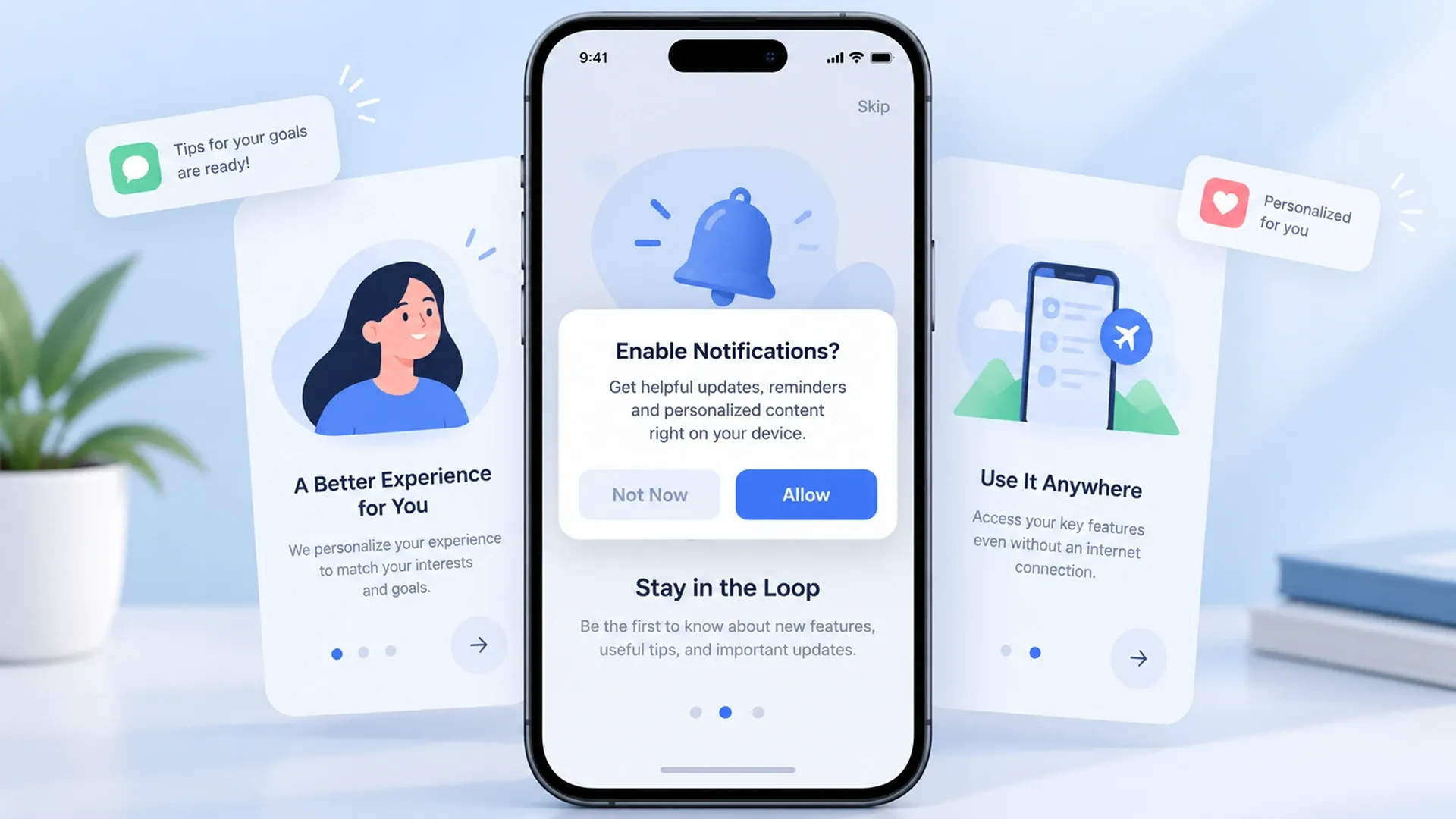
Downloads are only the beginning — the real challenge is keeping users coming back. Mobile apps succeed when they give people a reason to open them regularly, rather than leaving them forgotten on a home screen. A handful of features consistently drive stronger engagement:
- Push notifications, typically delivered through services like
APNsorFCM, timed around real user behavior - Personalization that adapts content and offers to each user
- Offline access so core features work without a connection
- Fast, frictionless onboarding that gets users to value quickly
None of these work in isolation. A well-timed notification only helps if the app it leads back to is fast and easy to use — engagement features amplify a good app experience, they don't replace it. That underlying experience comes down to deliberate UI/UX design, not just clever notification timing.
Testing Across a Fragmented Device Landscape
Unlike a website that renders in a browser, a mobile app has to run reliably across a wide range of phones, screen sizes, and operating system versions — many of which a development team will never personally own, a challenge Google's own Android device distribution data illustrates well. Skipping thorough testing is one of the most common ways otherwise well-built apps end up with poor reviews, since a bug that only appears on one device or OS version can quietly drive away a meaningful slice of users.
- Testing on real devices, not just simulators or emulators
- Covering both the newest and older, still-common OS versions
- Checking performance under weak or intermittent network connections
- Verifying that updates don't silently break existing functionality
Why App Strategy Comes Before Development
It's tempting to jump straight into design and development, but the businesses that get the most value from mobile apps start with a clear strategy: who the app serves, what specific problem it solves, and how success will be measured. Skipping this step often leads to apps packed with features nobody asked for, while the one or two things users actually need get buried.
A focused app that does a few things extremely well consistently outperforms a bloated one trying to do everything.
Mobile app development sits at the intersection of technical decisions and business strategy. Choosing the right platform approach, designing for genuine engagement, and starting with clear strategic goals all shape whether an app becomes a lasting part of a customer's routine or a forgotten icon. Businesses that treat their app as an extension of the customer relationship — not just a feature checklist — build products that keep users coming back. Much like our frontend development guide explores for the web, the same fundamentals of speed, clarity, and accessibility carry over directly to mobile.