IM Digital integrated the OpenAI API into BulkBazaar's backend, building an AI product content writer and a governance layer keeping every generated field under human review before publishing.
Project Name
BulkBazaar
Category
AI Automation
Services
AI Integration & LLMs

Project Overview
BulkBazaar is a B2B wholesale sourcing platform connecting Chinese and Indian manufacturing hubs with Indian retailers, dealers, e-commerce sellers, corporate buyers, and wholesalers, built on Next.js, Payload CMS, and the OpenAI API. IM Digital designed and integrated the platform's AI/LLM layer: an AI-assisted product content workflow for staff, plus the governance architecture controlling every AI integration across the system. One principle held throughout: the frontend consumes structured content through Payload APIs, records stay backend-controlled, and AI is scoped strictly to assist, summarize, and recommend, with final approval always resting with authorized staff, never the AI.

Project Summary
IM Digital added an OpenAI-powered product content writer to BulkBazaar's backend, cutting manual drafting effort while keeping every generated field subject to staff review before publishing.
BulkBazaar's catalog spans wholesale products sourced from Chinese and Indian manufacturers, each needing buyer-ready titles, descriptions, specs, FAQs, and SEO metadata. The client needed to speed up this workload without an AI system publishing unverified claims. The goal was an AI layer drafting from verified facts, flagging gaps, and leaving staff in control of what got corrected, approved, and published.
IM Digital defined the core principle governing AI: the frontend reads structured data via Payload APIs, records stay backend-controlled, and AI only assists, never approving or publishing alone.
The backend was connected to the OpenAI API so staff-submitted facts and image context could be sent as scoped input, with prompts constrained to supplied data, never inventing missing attributes.
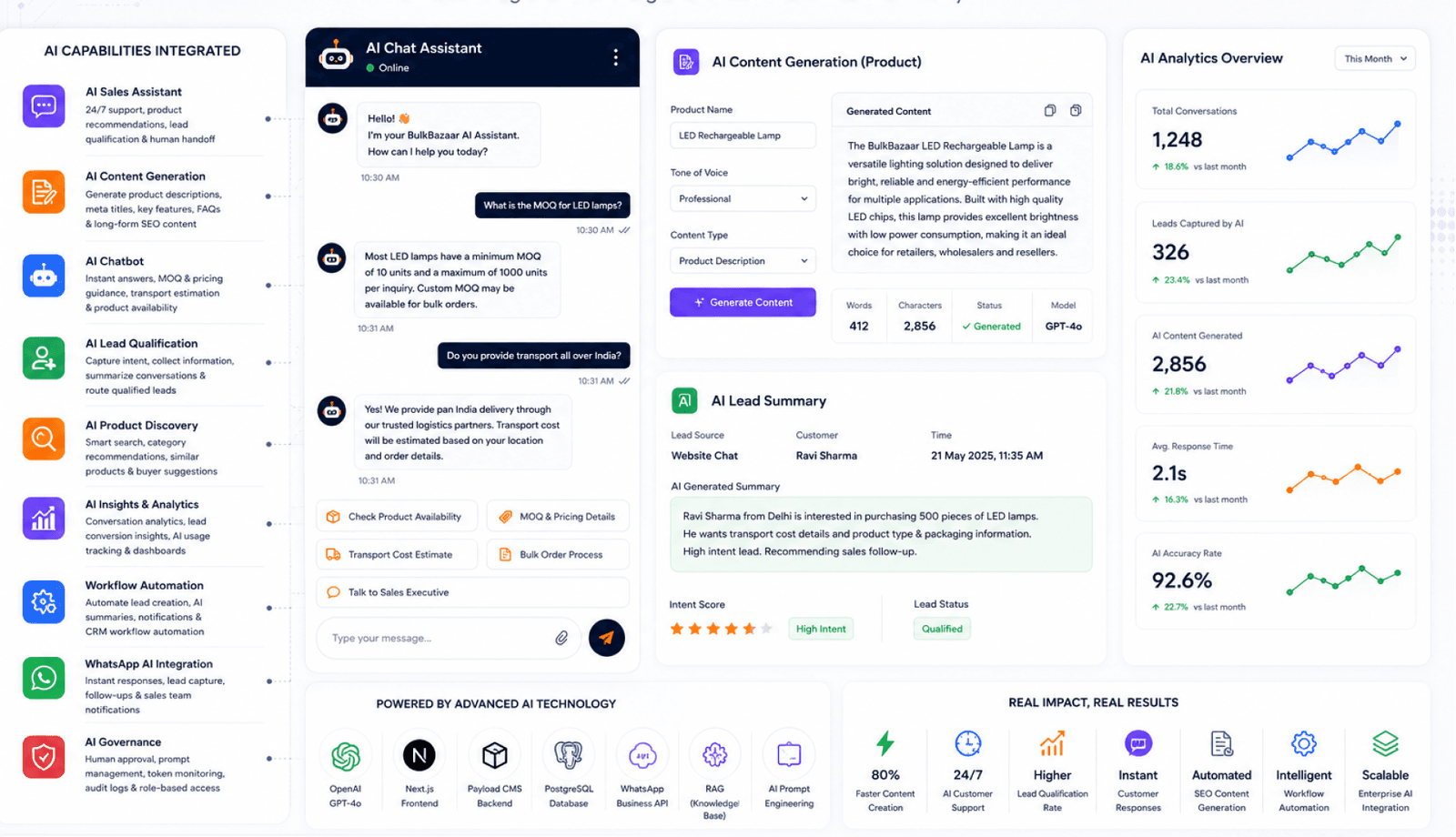
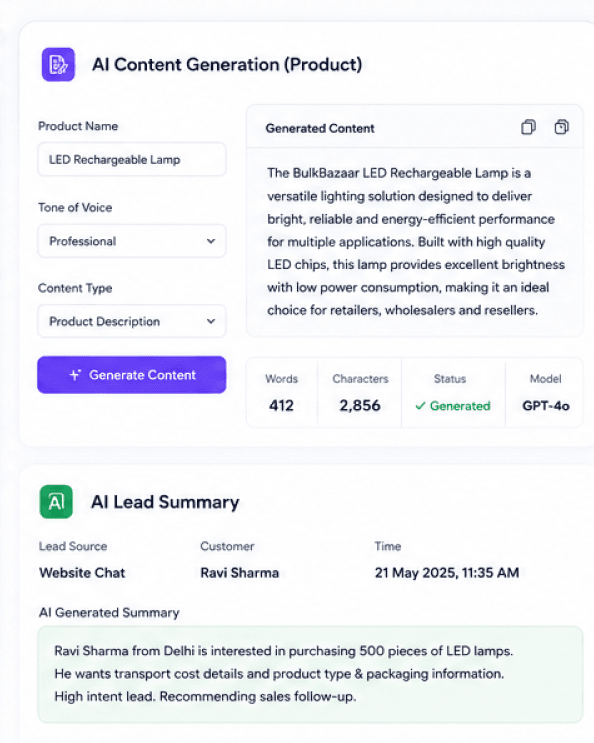
An AI-assisted workflow was built into the product form: staff supply minimum facts and images, the AI proposes titles, descriptions, features, specs, FAQs, and SEO fields, editors review each.
Every draft was tied to a generation timestamp, model, and triggering user, with field-level accept, edit, reject, and regenerate controls, logging, and a mandatory approval record before publishing.
Service Delivered
IM Digital delivered the OpenAI API integration architecture, an AI-assisted product content writer for the backend, and governance controls covering every AI feature across BulkBazaar's platform.
Service Showcase
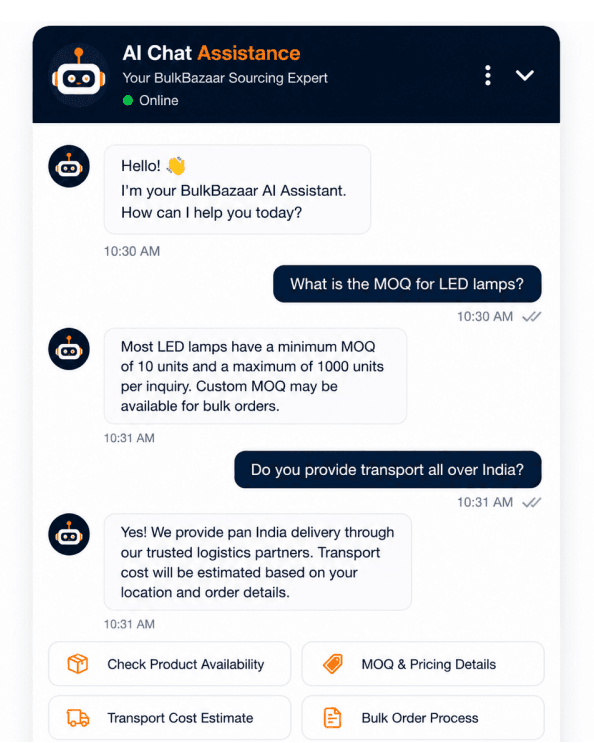
Staff supply product facts and images; the OpenAI API drafts titles, descriptions, specs, FAQs, and SEO fields; editors review, correct, and approve every field before it reaches the live catalog.
Whether you need scalable software development, AI integration, SEO optimization, or complete digital transformation, our team is ready to help your business grow globally.
Business Challenge
BulkBazaar's catalog required consistent, buyer-ready content for products sourced from Chinese and Indian manufacturers, each with its own working name, category, material, intended use, and package quantity. Writing titles, descriptions, features, specification tables, FAQs, and SEO metadata by hand for every listing was slow and inconsistent. Introducing AI assistance carried a distinct risk: a language model could plausibly invent specifications or measurements never verified, and unchecked content could misrepresent products moving through real B2B transactions. BulkBazaar needed drafting speed without surrendering accuracy, and every AI action governed by one auditable standard.

Writing product titles, descriptions, specifications, FAQs, and SEO metadata by hand for every listing was slow and inconsistent, and could not scale against a catalog fed by continuous sourcing.
A language model drafting from incomplete facts could plausibly generate specs or measurements never supplied or verified, unacceptable for products moving through real wholesale transactions.
The platform had no existing framework for what an AI feature could touch, so each new AI capability risked being built with its own inconsistent rules for review, correction, and publishing control.
Without a shared architecture, staff would have no consistent way to see which fields were AI-generated, who approved them, what facts were supplied, or how much each AI feature was costing to run.
BulkBazaar needed certainty that no AI-drafted content could ever reach the live catalog without a recorded human approval step, regardless of which AI feature or workflow produced it.
Strategic Approach
IM Digital treated the AI/LLM integration as its own implementation phase, brought in only after BulkBazaar's catalog, storefront, and lead and sales systems were already in place. This sequencing was deliberate: structured product data and workflows had to be stable in Payload CMS before any AI layer sat on top of them. Every AI integration, including the content writer, was built against one principle: the frontend reads structured content through Payload APIs, records stay backend-controlled, and AI is scoped to assist, summarize, and recommend, with final approval resting with staff. Field-level review, source-fact preservation, and usage logging were built in from the start.
Catalog, storefront, and lead and sales systems were completed before any AI feature was introduced, so the AI layer would operate on stable, correctly structured data from day one rather than adapting to it afterward.
A single principle governed every AI integration: the frontend consumes structured data through Payload APIs, records stay backend-controlled, and AI only assists and recommends, never approving or publishing anything on its own.
Staff-supplied minimum facts and image context were the only inputs sent to the OpenAI API, with prompts prohibiting unsupported claims, certifications, or measurements, and requiring uncertain fields to be flagged, not invented.
Rather than an accept-or-discard draft, editors could accept, edit, reject, or regenerate each generated field individually, so a strong AI-drafted description did not have to be discarded just because one specification needed correction.
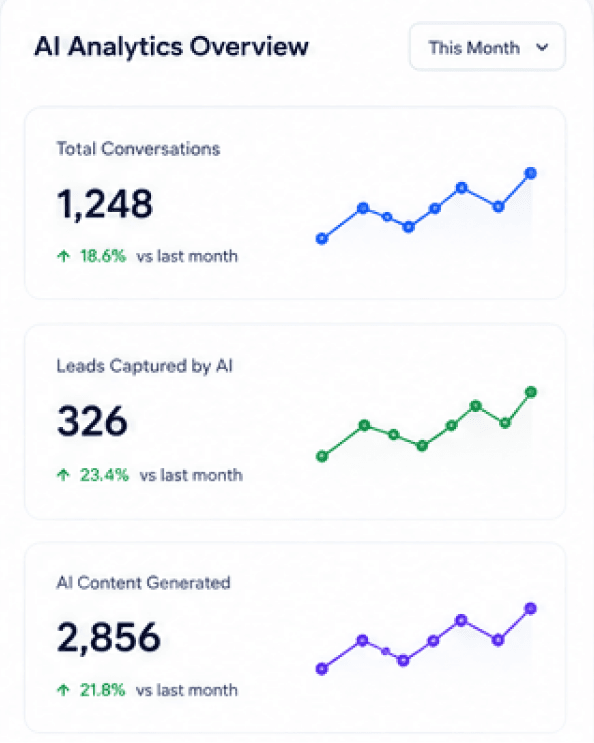
Generation timestamp, model, triggering user, source facts, token usage, and cost were logged for every AI action from the outset, surfaced through an AI Workspace and AI Report covering content generation, chatbot, and lead features alike.
Result
The AI-assisted content writer cut manual drafting effort across BulkBazaar's catalog while every generated field stayed subject to staff review and a recorded human approval before publishing.
-65%
Draft Creation Time
70%
Fields Accepted As-Is
100%
SEO Metadata Coverage
-50%
Staff Review Time
Whether you need scalable software development, AI integration, SEO optimization, or complete digital transformation, our team is ready to help your business grow globally.
Explore more software, AI, SEO, and digital marketing projects where we've helped brands achieve real, measurable growth.

IM Digital rebuilt Profile House's flat product listing into a structured, CMS-driven B2B website with category hierarchy, technical product pages, and intent-based enquiry forms for buyers.

Search Engine Optimization
Search Engine Optimization
How IM Digital rebuilt Profile House's URL architecture, internal linking, redirects, and structured data, turning a flat, unstructured product listing into a fully crawlable B2B platform.

See how IM Digital built a channel-specific social media strategy for Profile House, an aluminium profile manufacturer, converting technical content into qualified architect, dealer and OEM enquiries.
Browse our complete portfolio of digital work across every industry we serve.
Explore All WorkAI integration and LLM governance means every AI-drafted field stays subject to human review before publishing, rather than an AI system approving content on its own. BulkBazaar's integration connects the OpenAI API to a product content workflow where staff supply facts and images, and editors accept, edit, reject, or regenerate each field. See AI Integration & LLMs for platforms.
Fact-scoped prompting restricts an AI model to only the facts and images staff actually supply, prohibiting it from inventing certifications or measurements never verified. BulkBazaar's content writer cut draft creation time 65% this way, with 70% of AI-generated fields accepted as-is once every draft stayed grounded in supplied data rather than guesswork.
Platforms need an audit trail because publishing accountability depends on knowing exactly who approved what, and when. BulkBazaar logs generation timestamp, model, triggering user, source facts, and token cost for every AI action, surfaced through an AI Workspace and report so no content reaches the live catalog without a recorded human approval step.
Yes, letting editors accept, edit, reject, or regenerate each generated field individually means a strong AI-drafted description doesn't get discarded just because one specification needs a fix. BulkBazaar built this into its workflow, achieving 100% SEO metadata coverage across the catalog while cutting staff review time 50%.
Getting started means completing your structured data and core workflows first, so an AI layer has stable, correctly modeled information to draw from rather than adapting around gaps. IM Digital sequenced BulkBazaar's AI layer this way, after its catalog and sales systems were already in place. Contact our team to plan your integration.

 Get a Quote