
 Get a Quote
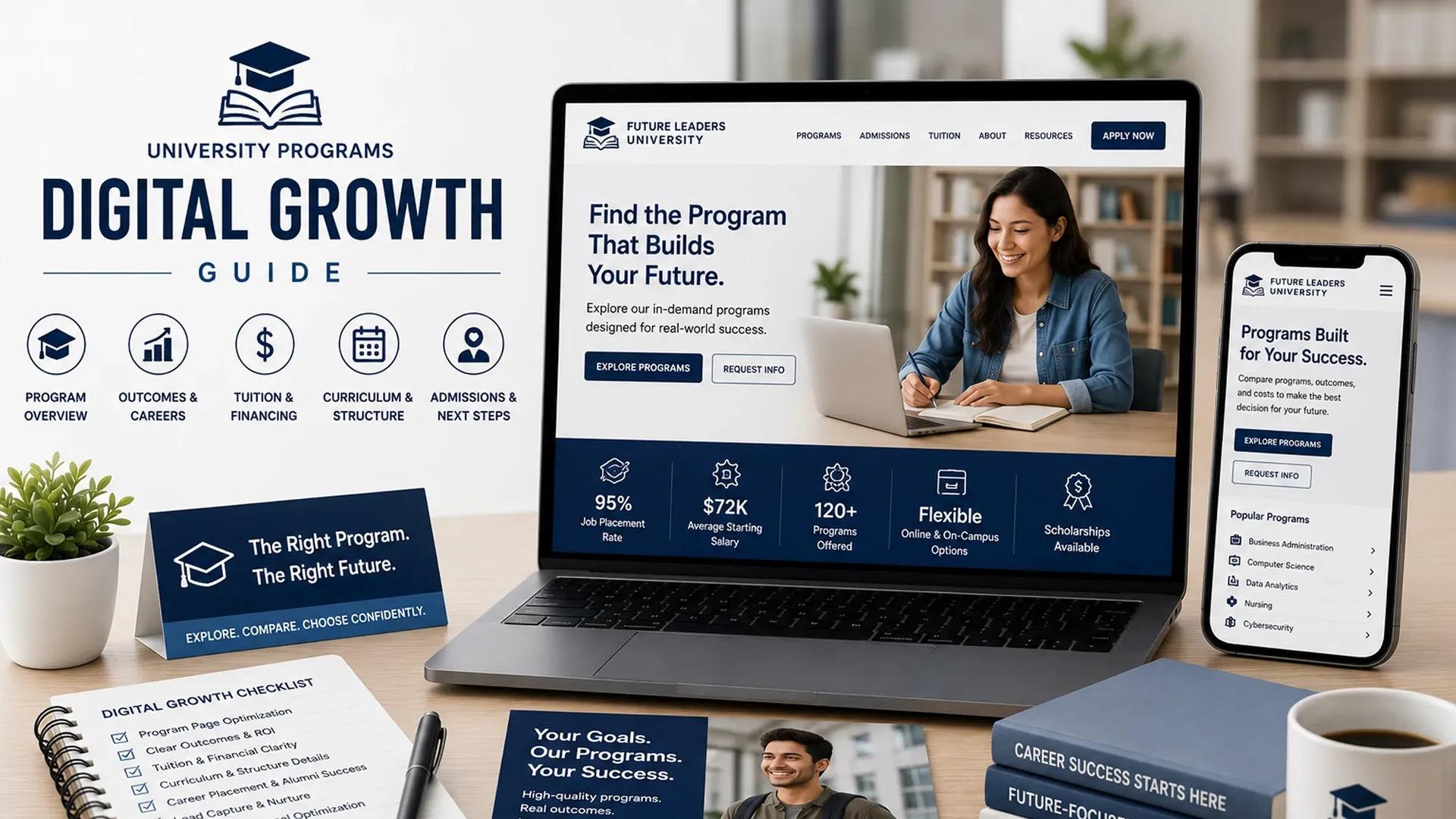
Learn how university programs grow with program pages, admission funnels, SEO, student lead generation, content marketing, and campaigns.
Students researching university programs today rarely commit to an application based on a single glossy brochure — they compare outcomes, tuition, career placement rates, and program structure across several schools before deciding where actually to apply. A strong university program digital marketing guide starts by treating every program page as a decision-making tool, not a marketing pamphlet, because that's genuinely how prospective students use it long before they ever speak with an admissions counselor.
Making Program Pages Answer the Real Question: What Do I Get?
Too many program pages describe course titles and credit hours without ever answering what a prospective student actually wants to know — what a graduate goes on to do, what the program genuinely demands, and whether it's realistic given their background. Rewriting pages around outcomes rather than syllabus structure changes how seriously visitors take the program, and it's often the difference between a page that gets bookmarked for comparison and one that gets closed within seconds.
Page Element | Generic Approach | Outcome-Focused Approach |
|---|---|---|
Course description | Lists titles and credit hours | Explains skills gained and career relevance |
Career outcomes | A vague "many career paths" statement | Specific job titles, placement rates, and alumni examples |
Eligibility | Buried in a separate admissions PDF | Clearly stated directly on the program page |
Building Admission Funnels Around How Students Actually Decide
Digital marketing for university programs works best when the admission funnel mirrors the real decision process — initial interest, comparison against other programs, and finally a specific question that needs answering before applying. The same principle that helps private schools convert curious parents into scheduled tours applies here: a funnel built around genuine decision points converts far more reliably than one borrowed from a generic template.
- Program-specific landing pages instead of one generic admissions form
- Clear next steps immediately after a prospective student submits interest
- Retargeting content addressing the specific program they viewed
- A visible, direct way to ask an admissions counselor a real question
Ranking for the Searches Prospective Students Actually Run
Good university program SEO tips start with understanding that prospective students search using very specific language — program names, career outcomes, and comparisons against other schools — rather than generic higher-education terms. Content that speaks directly to that intent, supported by transparent outcome data similar to what's published through the U.S. Department of Education's College Scorecard, earns organic visibility that paid campaigns alone can't replicate.
Helping Transfer and Working Applicants Find Their Path
Not every prospective student is a recent high school graduate applying for the first time — many are transferring credits from another institution, returning after time away, or juggling a job while considering a part-time or evening format. Program pages that clearly address these paths, rather than assuming every visitor fits the same traditional applicant profile, capture a meaningful segment of prospective students that a one-size-fits-all admissions page quietly turns away.
Turning Inquiries Into Completed Applications
Capturing interest is only half the job — effective student admission lead generation depends on what happens in the weeks between a first inquiry and a submitted application, a stretch where many prospective students quietly lose momentum or get pulled toward a competing program that followed up faster. A structured sequence of reminders, deadline alerts, and answers to common application questions keeps that momentum from fading.
A prospective student who goes three days without a response has usually already started looking at someone else's program page.
Supporting Students With Real Content, Not Just Ads
Guides that walk through the application process step by step, financial aid explanations written in plain language, and honest answers to common hesitations do more to build trust than another retargeting ad ever could, which is exactly the same content-first approach that helps online university programs build confidence with a similarly research-heavy audience.
Growing enrollment for a university program comes down to writing program pages that answer real questions, building funnels around genuine decision points, ranking for the specific searches students run, addressing the needs of transfer and working applicants, following up quickly enough to keep momentum going, and supporting the decision with honest content. Programs that combine all of this convert far more of their traffic into completed applications each admissions cycle, regardless of the format a student ultimately chooses.