Get a Quote
Learn backend best practices for scalable systems using APIs, databases, architecture, security, performance, automation, and reliable workflows.
Most backend advice covers what a system should do. Building scalable backend systems is really about what happens once real traffic and real data start pushing against the assumptions that worked fine in early testing — and the specific patterns teams reach for once that pressure actually arrives.
Scaling Up Before Scaling Out
Adding a bigger server is almost always simpler than redesigning a system to run across many smaller ones, which is exactly why vertical scaling is usually the right first move rather than an outdated one. Horizontal scaling — running the same service across multiple machines — solves problems vertical scaling eventually can't, like surviving the failure of a single server, but it introduces real complexity around state, session handling, and coordination that isn't worth taking on before it's actually needed.
Caching the Right Things at the Right Layer
Caching is one of the highest-leverage tools for scaling, but only when it targets data that's expensive to compute and doesn't change on every request:
- A CDN layer for static assets and pages that rarely change
- An application-level cache for expensive computed results, like dashboards
- A database query cache for repeated reads on data that changes infrequently
- Clear invalidation rules so stale cached data doesn't quietly outlive its accuracy
Letting Queues Handle What Doesn't Need to Happen Instantly
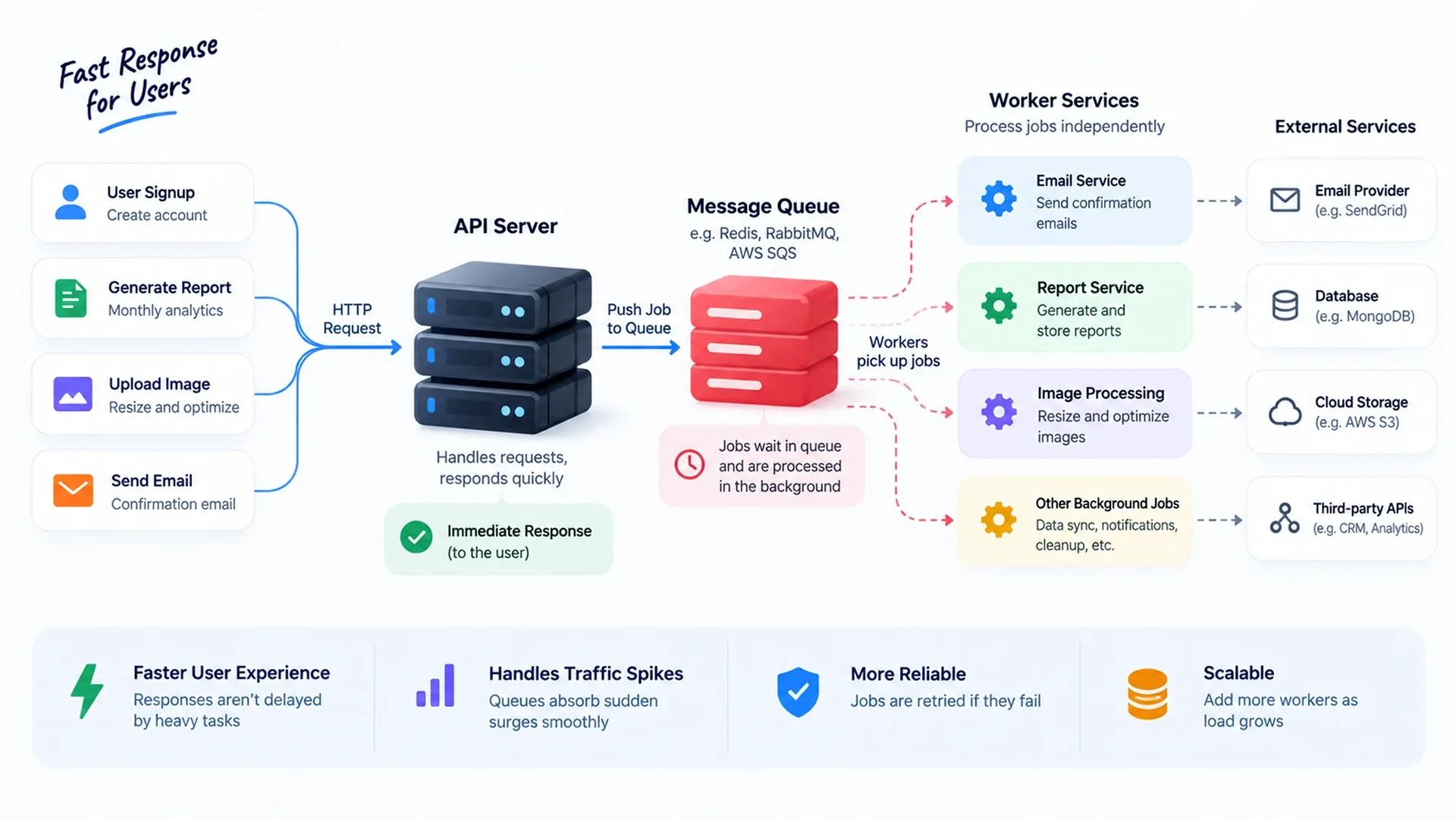
Not every action a user triggers needs to finish before a response goes back to them. Sending a confirmation email, generating a report, or resizing an uploaded image can all be pushed onto a queue and processed moments later, which keeps the main request fast and gives the system room to absorb sudden spikes without falling over. A queue also acts as a natural buffer during traffic surges, smoothing out bursts that would otherwise overwhelm a system trying to process everything the instant it arrives.
Splitting a Monolith Only When the Pain Is Real
Microservices solve organizational and scaling problems that mostly show up once a team and codebase have genuinely outgrown a single deployable unit — coordinating dozens of engineers, or scaling one specific piece of functionality independently of everything else. Splitting too early, as Martin Fowler's writing on microservices has pointed out for years, usually just recreates a monolith's problems across a network, with added latency and operational overhead as the reward.
You shouldn't start with microservices, even if you're confident your application will be big enough where it will end up being worthwhile.
Scaling the Database Without Losing Track of the Data
Databases tend to be the hardest part of a system to scale, because unlike a stateless API server, data can't simply be copied onto a new machine and forgotten. The most practical database scaling tips are usually the least exciting ones: read replicas handle growing read traffic well, sharding splits data across multiple databases for write-heavy systems, and running a query plan through EXPLAIN ANALYZE before assuming an index will fix a slow query saves far more time than guessing does.
Following API Architecture Best Practices as Systems Grow
The API design decisions that seemed minor at launch — versioning, pagination limits, rate limiting — become expensive to change once external teams or partner integrations depend on them. Sound API architecture best practices lock in sensible defaults early, even before they feel necessary, avoiding the awkward position of introducing breaking changes to consumers who never agreed to absorb them. A versioned API that changes deliberately earns far more trust from integrating teams than one that changes silently and breaks their code without warning.
Scalable backend systems rarely come from one big architectural decision — they come from choosing the simplest scaling method that solves the actual bottleneck, caching deliberately, queuing what can wait, splitting services only once the pain justifies it, and treating both the database and the API contract as things that get harder to change the longer they're left alone. For the fundamentals these patterns build on top of, our backend development guide covers APIs, databases, and security from the ground up.